
Sustainable Finance & Climate Resiliency
Creating resilient and sustainable communities to benefit all we serve.
At Fifth Third, sustainability is guided by our ambition to be the one bank people most value and trust. We seek to create durable socioeconomic value while managing the opportunities and risks that shape our business and the communities we serve. As such, our corporate sustainability strategy is grounded in an understanding of stakeholder impacts, business risks and opportunities, and the evolving expectations of shareholders, customers, employees, communities, and regulators.
Fifth Third’s commitment to building a sustainable future requires disciplined action across innovation, finance, operations and risk management. We focus on delivering long-term value by advancing products and solutions that drive economic progress, support domestic investment and manufacturing, and address evolving environmental and technological realities. This approach reflects our responsibility to customers and shareholders, as well as our role in strengthening resilience and enabling sustainable growth across the communities we serve.
Innovation and sustainable finance are central to this effort. We continue to evolve products and platforms, align capital to support business growth and community development, invest in America’s economic strength, improve resiliency to climate-related socioeconomic disruptions, and reduce impact from our own operations. Across each area, we are committed to the responsible use of technology—pairing strong governance with forward-looking solutions to support resilient growth and sustainable progress.
Fifth Third delivers this through four strategic initiatives:

Sustainable Finance

Sustainable Communities

Climate Resilience & Adaptation

Sustainable Operations
Sustainable Finance
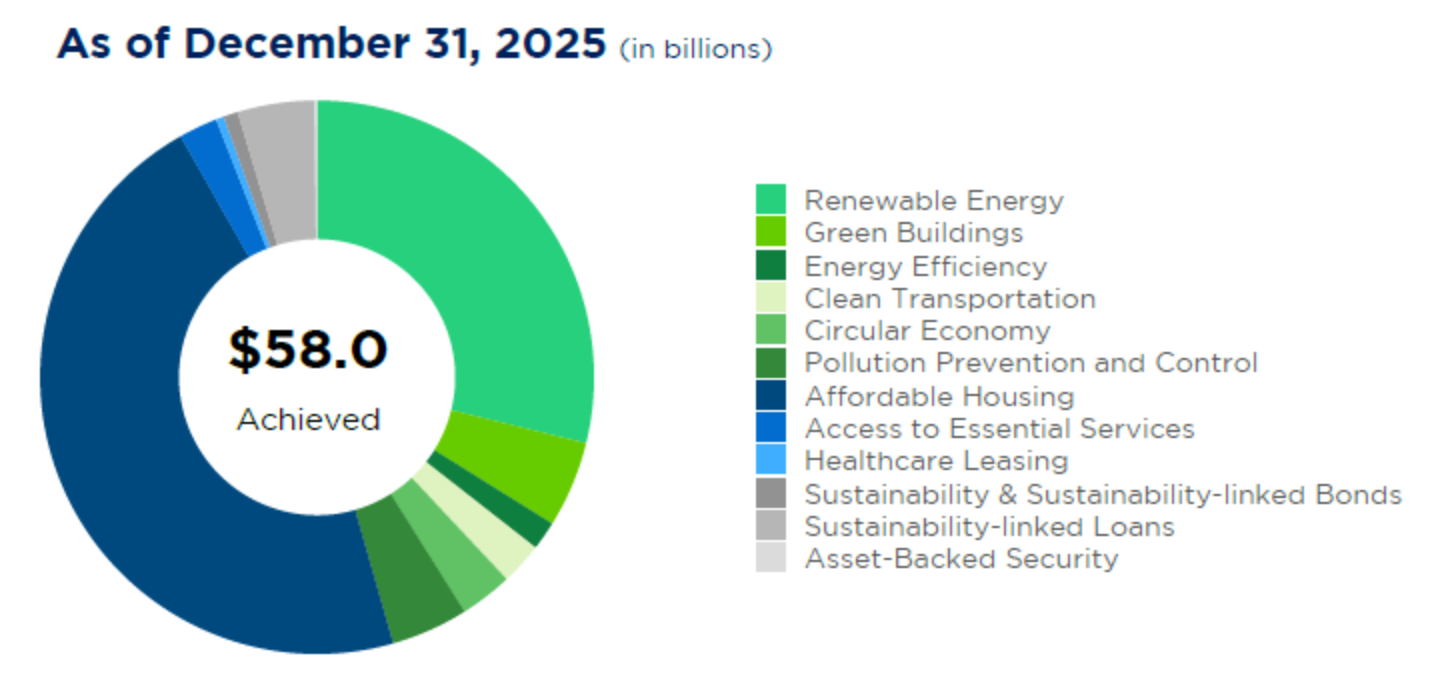
Our ambitious $100 billion environmental and social finance commitment (2021 - 2030), reflects our intent to deploy capital in support of environmentally sustainable and socially inclusive activities. Through the provision of targeted financial solutions, we see sustainable finance as both a driver of long-term business growth and a means to create meaningful, positive impact for our stakeholders.
Activities contributing to our Sustainable Finance target are business-decision driven and are intended to capture business opportunities in eligible sustainable finance categories. The Sustainable Finance initiative does not limit or restrict Fifth Third’s ability to provide financial services to any other lawful business or client activity.
Through 2025, Fifth Third has delivered more than $58 billion in environmental and social finance, representing measurable progress towards our $100 billion commitment.
Sustainable Communities
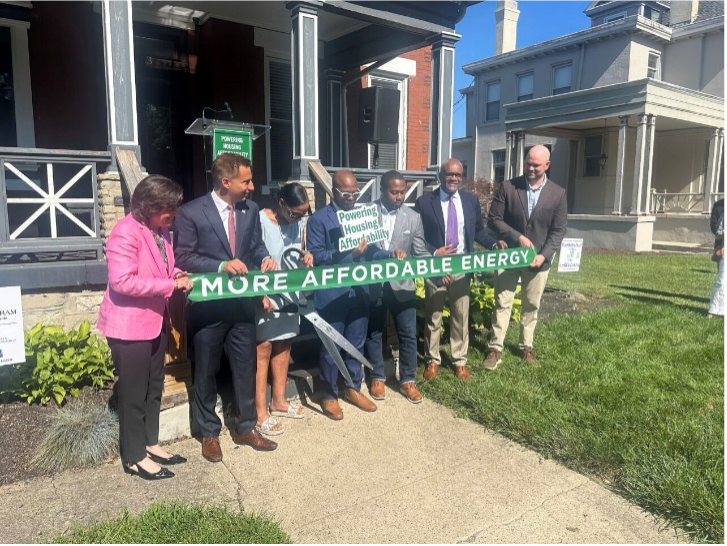
Across Fifth Third’s footprint, rising energy costs, aging infrastructure and increasing severe weather events are putting pressure on households and small businesses—threatening reliability, competitiveness and recovery, with the greatest impact on LMI and underserved communities.
Fifth Third’s Sustainable Communities initiative is the Bank’s response to these interconnected challenges. Grounded in a place‑based, market‑oriented approach, we seek to strengthen community outcomes while building institutional capability. Rather than relying on one‑time interventions, the strategy emphasizes durable financing platforms, trusted intermediary partnerships and scalable models that align community impact with Fifth Third’s core banking expertise.
Fifth Third’s work in energy affordability, access and resiliency is guided by three interrelated objectives: enabling energy affordability, supporting energy independence, and strengthening resiliency and revitalization. These objectives are prioritized in communities where rising energy costs, infrastructure constraints and changing climate exposure pose the greatest risks to economic stability and long‑term opportunity.
Climate Resilience & Adaptation
Climate-related risks can arise from the impact of extreme climatic events and efforts to address them, including changes in public policies, advances in technology, shifts in investor or public sentiments, and disruptive business model innovations. Banks and customers are likely to be affected by both the physical risks and transition risks associated with climate change.
Fifth Third’s climate risk playbook describes key components of our approach to managing climate-related risks and identifies key roles, responsibilities, and risk management programs. Additionally, key aspects, such as climate risk time horizons and their potential impact across traditional risk types, have been incorporated into the Enterprise Risk Management Framework.
Fifth Third recognizes climate risk as a transverse risk which could be realized in different ways across risk types. The risk also has the potential to materialize on different timelines based on the underlying risk type. These transmission channels and time horizons were identified and confirmed over the course of scenario analysis activities.
Climate-related risks follow the same risk aggregation and assessment processes as other risks. The severity and probability of climate-related risks identified through scenario analysis and risk expert discussions are reviewed through this process and have been refined over time.
While all climate-related risks are monitored qualitatively, acute weather events have been classified as an “emerging” risk which includes more rigorous quarterly evaluation. Emerging risks, along with material risks, are contemplated as Fifth Third develops our strategy. Additionally, the impact of our strategy on our risk profile, including material and emerging risks, is evaluated annually. At this time, this risk has not been determined to be material for Fifth Third, but continues to be evaluated for changes in risk level.
Fifth Third began integrating climate risk considerations across a number of risk programs and will continue to make enhancements as appropriate. As an example, enhancements made to our business change risk program ensure appropriate mitigation strategies and controls are considered when identifying initiatives which may impact our climate risk exposure.
Sustainable Operations
Operational sustainability–the reduction of Fifth Third’s own environmental and carbon footprint–has been a core pillar of our environmental sustainability program since its inception in 2010.
Reducing our environmental footprint is central to how we manage our operational impacts and is a key driver of financial savings and operational efficiency. Fifth Third has established internal operational sustainability goals that focus on the areas where we have the greatest level of control and accountability.
Building upon the successful achievement of its initial goals, Fifth Third adopted a new and more ambitious set of operational targets in 2022, to be achieved by 2030. These goals reinforce our focus on the most material areas of operational sustainability and underscore our leadership within the financial services industry, including our commitment to reduce our location-based greenhouse gas emissions by at least 75%.
Since 2019, we have sourced 100% renewable electricity equivalent to our operational electricity use, complimented by a sustained emphasis on energy efficiency. By the end of 2024, we exceeded our original energy reduction target, achieving 45% reduction in operational energy use. As of 2025, our greenhouse gas emissions have declined by more than 60%, and we remain on track towards our long-term operational sustainability objectives.
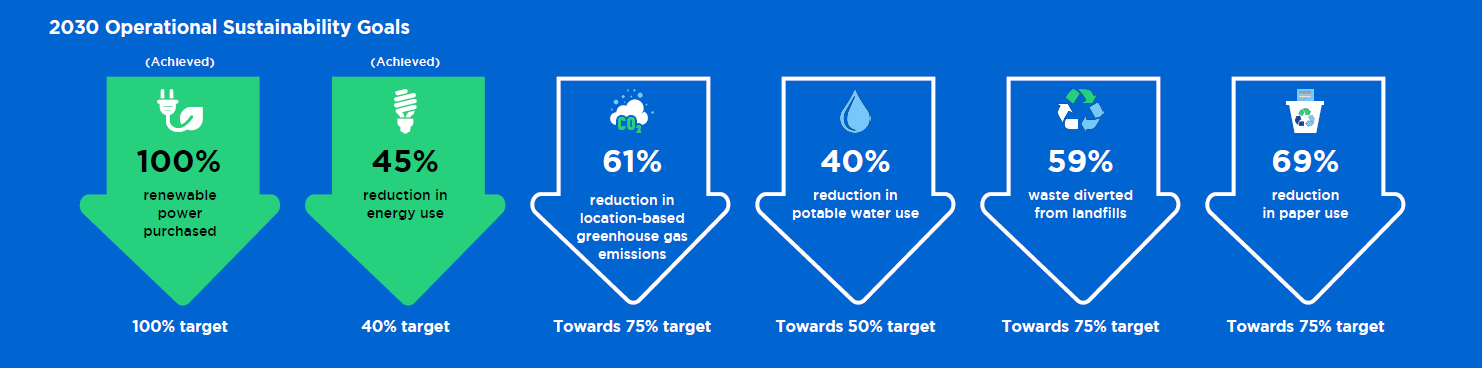
The energy and water consumption KPI calculations are calculated for owned and ground-leased buildings where Fifth Third receives a utility bill. GHG emissions KPI is calculated based on all Scope 1 and Scope 2 emissions. Waste diversion rate includes all locations where Fifth Third receives a waste bill and data. The paper KPI calculations are calculated for office paper purchased through Fifth Third’s primary supply vendor. GHG emissions, energy, paper and water goals are relative to a 2014 baseline. Verification statements are available in the Additional Disclosures section of ir.53.com. Fifth Third’s operational sustainability goals have a 2014 baseline year.