

From Earth to Orbit: The Emerging Economics of the New Space Age
Understanding the background and investment implications of the commercial space sector.
Authors: James Bax, CFA®, Equity Research Analyst & Ivan Lo, CFA®, Equity Research Analyst
Key takeaways:
- The space economy is positioned for rapid growth, with trillion-dollar potential in the next decade.
- Declining cost barriers are transforming space from a niche domain into a platform for widespread commercial activity.
- Government investment and defense priorities continue to anchor and accelerate industry expansion.
A new phase of growth for the global space economy
Recent advances in launch capabilities, satellite development and renewed NASA activity are reshaping the space economy. No company reflects this shift more than SpaceX, which has grown from a high-risk startup into the world’s leading provider of launch services and low-Earth-orbit communications. More broadly, these advances signal the emergence of a commercially scaled space industry — one capable of lowering structural barriers, unlocking new markets and reshaping the global economy.
The space industry: A brief history
The space industry originated in the 1950s and 1960s during the U.S.-Soviet race to reach orbit, driven almost entirely by government funding and strategic priorities. In the decades after Apollo, the sector stagnated. Government agencies remained the primary customers, satellites became billion-dollar, zero-risk assets, and there was little incentive to adopt cost-reducing innovations. Private-sector efforts in the 1980s and 1990s also struggled, constrained by the absence of reusable rockets, precision manufacturing and affordable satellite platforms.
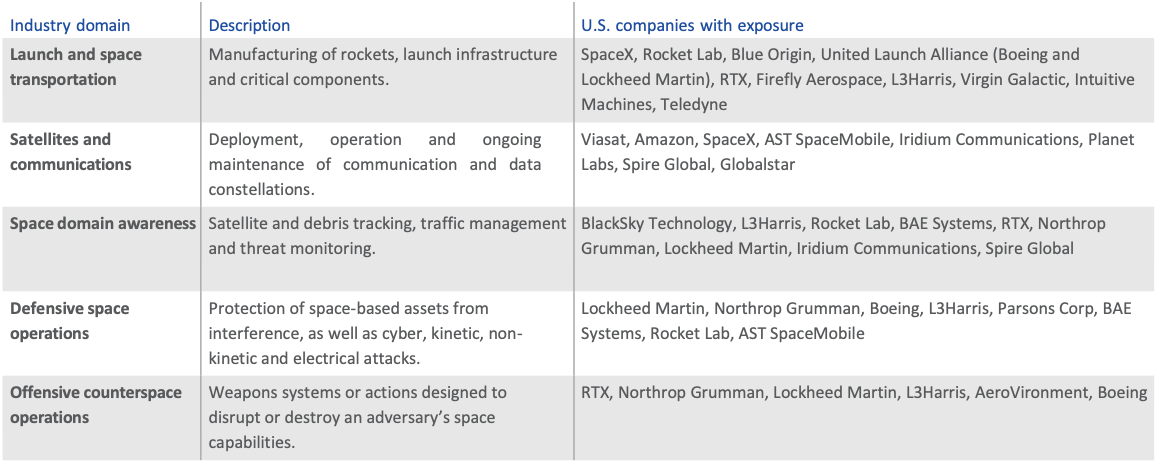
It was in this environment — one marked by high costs and limited commercial viability — that the stage was set for a new group of entrants betting that if launch costs fell, demand for access to orbit would expand beyond government. No company better exemplifies this shift than SpaceX, founded by Elon Musk in 2002 with the mission of making humanity a multiplanetary species. Today, SpaceX places more mass into orbit than all other launch providers combined and operates the largest low-Earth-orbit satellite constellation, Starlink.1 Yet SpaceX is only one of many companies, both new and longstanding, helping build the modern commercial space industry. Exhibit 1 summarizes the key domains across the space value chain, including manufacturing, launch, defense and space-based infrastructure.
Exhibit 1: Competition abounds across the space economy value chain
Source: Fifth Third analysis of industry reports and public filings.
SpaceX lowers the structural barriers to space
SpaceX seized on two highly disruptive innovations: the reuse of routine boosters to dramatically lower launch costs, and the near full verticalization of its supply chain, allowing the company to design, manufacture and iterate faster than competitors. While vertical integration typically increases fixed-cost intensity, SpaceX mitigated this burden by standardizing around a single reusable platform known as Falcon. Falcon’s modular architecture was not only well-suited to mass manufacturing but also reusable.
Critically, reusability converts single-use hardware that would ordinarily be expensed into a depreciable asset, allowing research and development and manufacturing costs to be amortized across multiple missions, materially improving unit economics and lowering launch costs. While not directly comparable today to SpaceX’s launch cadence or cost structure, competitors such as Blue Origin, founded by Jeff Bezos, are developing reusable rockets and landers for lunar missions, while companies such as Firefly Aerospace, Rocket Lab, Northrop Grumman and the United Launch Alliance — a partnership between Lockheed Martin and Boeing — have also successfully launched rockets into space.
Unlocking new markets
By lowering the barrier to orbit and making launch capacity more available, SpaceX has expanded what is economically viable in space — unlocking new markets and accelerating growth in established ones. For example, the lower cost curve enables new "space-as-infrastructure" businesses, such as Starlink’s broadband services, which in turn fuel a flywheel of additional launches and satellites, expanding demand for new specialized manufacturing and launch service providers. Like Starlink, AST SpaceMobile has used space-enabled connectivity to develop a direct-to-device satellite service, allowing standard, unmodified smartphones to connect in dead zones. Another example is Rocket Lab, which is leveraging its launch expertise to expand into new markets by securing contracts tied to emerging technologies, including the development and testing of hypersonic missiles.
Looking further ahead, space-based computing for artificial intelligence and related data services could represent another new market. In theory, as launch costs decline and space-qualified hardware advances, orbital data centers could relieve key terrestrial constraints — power, cooling, land and permitting — by leveraging abundant solar energy and radiating waste heat into space, helping to lower operating expenses. In parallel, orbital "data embassies" could provide physically isolated backups for highly sensitive datasets.2 Meanwhile, geospatial and Earth observation data — inputs already central to defense and national security operations — could see broader commercial adoption in industries such as logistics, communications and retail.
Reshaping the global economy: Space race 2.0
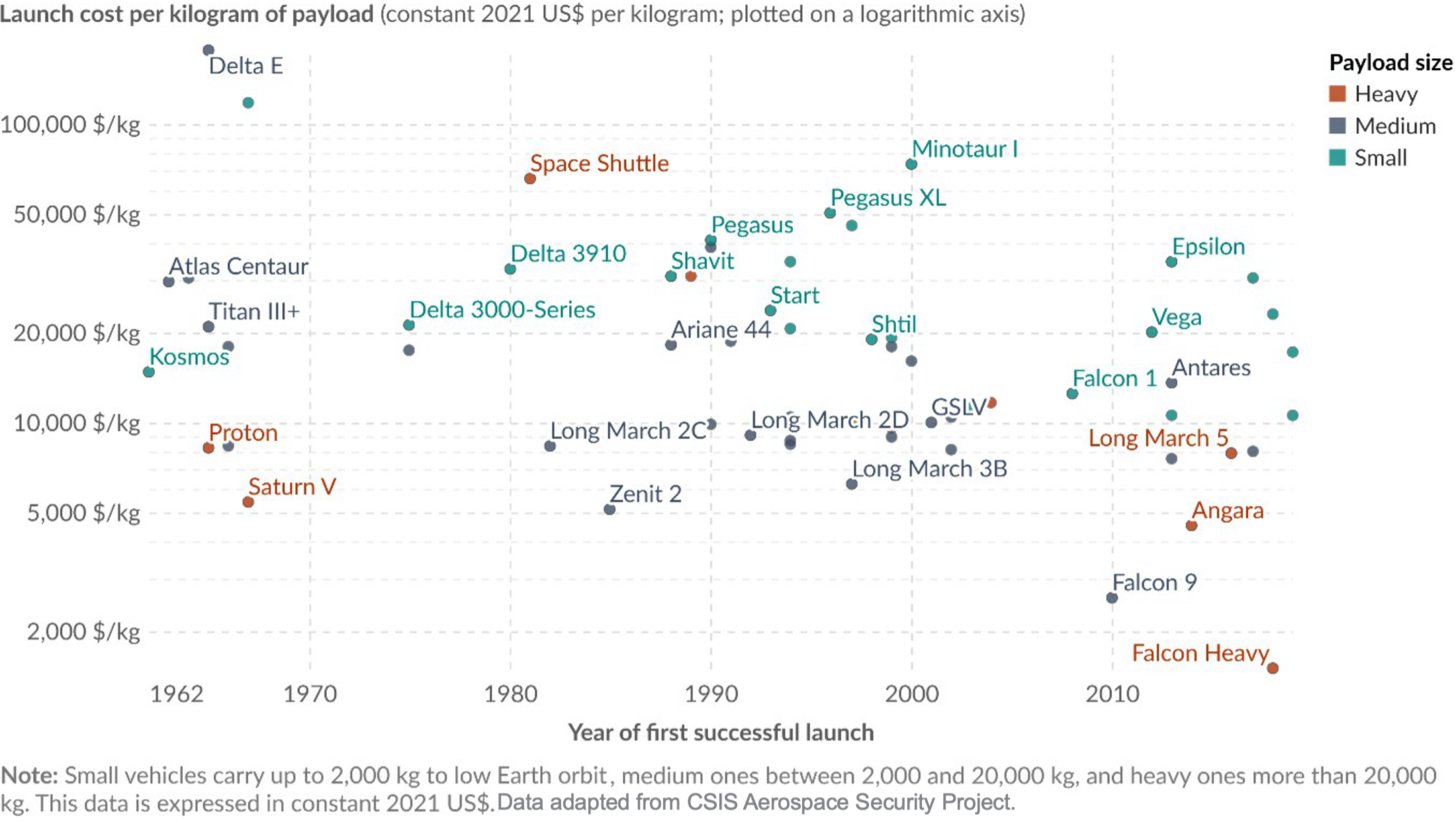
The step change in how cheaply and frequently the world can access space underpins a rapidly expanding space economy, which NovaSpace estimates reached approximately $626 billion in 2025, generating high-paying jobs and fostering innovation with meaningful spillover benefits across the broader economy.3 The strongest driver of continued growth is likely sustained launch cost deflation, enabled by fully and rapidly reusable super-heavy systems. SpaceX’s Starship exemplifies this shift, with long-term launch costs potentially approaching $100 per kilogram for large payloads4 — a massive improvement relative to historical benchmarks, as illustrated in Exhibit 2.
Exhibit 2: Cost of space launches to low Earth orbit
Source: Edouard Mathieu, Pablo Rosado and Max Roser; "Space Exploration and Satellites," Our World in Data; 2022; https://ourworldindata.org/grapher/cost-space-launches-low-earth-orbit.
At the same time, satellite miniaturization, software innovation and surging demand for space-derived data are expected to sustain growth as space-based capabilities evolve from specialized tools into foundational infrastructure embedded in day-to-day economic activity. Reflecting this transition, the World Economic Forum forecasts the space economy could grow at an average rate of 9% above global GDP, potentially reaching $1.8 trillion by 2035.5
As in the earliest days of the space industry, government prioritization remains a critical growth driver. Nation-states are once again shaping the trajectory of the space economy through policy, funding and strategic demand, acting as anchor customers and technology validators — a critical aid for commercial providers as they scale. Bloomberg Intelligence projects the global commercial and defense space market will generate $3.5 trillion in cumulative spending through 2030, driven by government and defense investment across space and counterspace programs, Earth observation and associated data services, and satellite communications and connectivity.6 In 2025, European Union member states’ defense spending reached approximately 381 billion euros, with the European Commission proposing an increase of 131 billion euros allocated to space and defense for the 2028-2034 budget cycle, a fivefold increase over the previous cycle.7 These dynamics are further intensified by China and Russia, which are rapidly advancing co-orbital interceptors, jamming capabilities, directed-energy systems and ground-based antisatellite weapons. As a result, resilient satellite constellations and counterspace capabilities are likely to remain top modernization priorities for years to come.
Conclusion
The rapid evolution of launch systems, satellite networks and commercial operating models marks a turning point for the broader space economy. As costs decline and access expands, markets once constrained by government funding and technical limitations are opening. SpaceX’s ascent illustrates what becomes possible when engineering advances intersect with new economic incentives, but the implications extend far beyond any single company. As use cases and new companies emerge, the most consequential question may be where the space economy grows from here — and how that value becomes reachable beyond the launchpad.
To learn more, contact your Fifth Third Private Bank advisor.