
How to Budget for Home Renovations
Upgrading your home can be costly, but with the right planning and financing, these home renovation budget tips can help you stay on track.
Your house is more than just a place where you live—it’s your home, your sanctuary, a space where memories are made. It’s no wonder, then, that many homeowners invest time and resources to make it the best it can be. A survey of more than 30,000 U.S. homeowners found that 56% of them tackled a renovation project in 2023, with the median amount spent reaching $24,000—up $9,000 since 2020.
Homeowners are undoubtedly pleased with all those updated kitchens and bathrooms. Blowing through their budget, not so much. While over three-quarters of homeowners develop a budget before starting their projects, only 34% stick to it.
To avoid a similar outcome, here are several steps you can take to create a realistic home renovation budget for your next project, whether big or small.
Do your research
When it comes to creating a home reno budget, don’t rely on guesswork or wishful thinking. Instead, use actual numbers from reliable sources to guide your planning.
Luckily, there are tons of publicly available resources that estimate how much different home improvement projects may cost. The U.S. Census Bureau conducts the American Housing Survey, which catalogs how much your fellow citizens pay for typical improvement projects. For example, a kitchen remodel costs an average of $26,973, according to 2025 data from Angi, while a new roof can be about $4,000 to $11,000 per thousand square feet, according to NerdWallet.
This doesn’t mean that your project will cost the exact same amount. Where you live, the specific finishes you choose, the age of your house and how well it has been maintained all influence the final price tag. But you can use those ballpark costs as a guide when receiving project bids from contractors or evaluating the cost of materials.
Prepare for unexpected costs
Precise budgets depend on specificity. Will your kitchen remodel use high-end marble, soapstone or more modestly priced tile? Are you replacing all the kitchen cabinets and the floor, or are you buffing, shining and repainting what you already have?
The more specific you can be about the materials and amount of work to complete an improvement project, the more accurate the budget. But even after considering the most minute details, it’s wise to pad your budget estimate. For example, add an extra 10% to 15% to your budget to cover unexpected expenses, which might include a rise in material costs, unforeseen repairs or additional labor. If the extra funds aren’t needed, they can be redirected to another project or saved for future use.
Do it yourself renovations
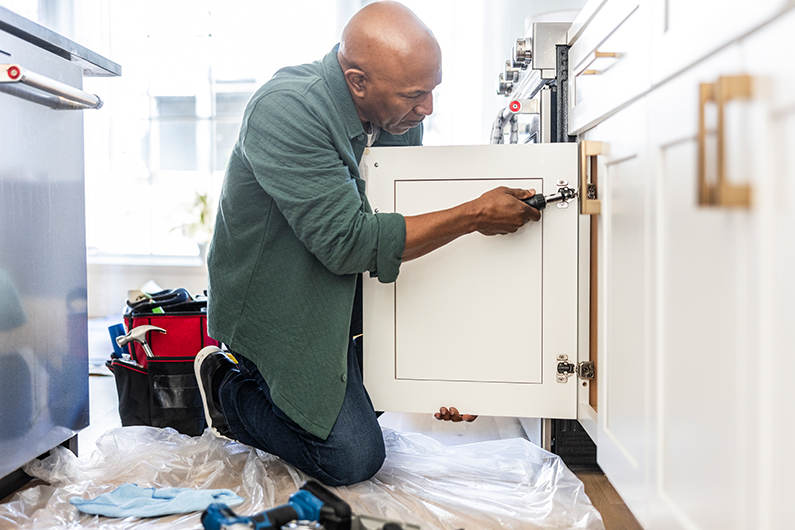
DIY renovations are a great way to save money and add a personal touch to your home. Whether it's repainting a room, installing new shelves, or updating fixtures, tackling projects yourself can be both rewarding and cost-effective.
By handling labor on your own, you can significantly cut down on contractor fees, which often make up a large portion of renovation costs. Some homeowners who have the skills and time to tackle plumbing, painting or drywall choose to save money by doing those more manageable projects themselves. The average DIY home improvement project costs about $2,500 compared with $6,352 when hiring a contractor.
Smaller projects, like adding new landscaping, replacing windows or installing a deck, typically cost $4,000 to $9,000 when done professionally—but just $1,000 to $4,000 when you DIY.
For larger projects, like remodeling a bathroom or renovating a bedroom, working with a professional can cost as much as $25,000 due to higher (and sometimes specialized) labor costs. Doing those yourself? About $4,000 to $7,000.
Get multiple estimates
If you decide to hire a contractor, start by asking friends who have completed similar projects for recommendations, checking the Better Business Bureau for any complaints against them, or browsing reputable home improvement platforms like Angi for top-rated professionals.
Always get multiple in-person estimates—keeping in mind that a contractor likely can’t provide an accurate quote without physically assessing the work site. The value of getting multiple estimates is that it helps you understand project costs in your area rather than just a national or state average.
And remember: Choosing the right contractor isn’t about picking the lowest bid—itt’s about finding someone who offers quality work at a reasonable price. Having several options puts you in a better position to make an informed decision.
Consider energy-efficient upgrades
Beyond traditional home improvements, energy-efficient upgrades can be a smart way to increase your home’s value and lower long-term utility costs. Improvements such as energy-efficient windows, solar panels or upgraded insulation can significantly reduce your energy consumption and environmental footprint.
Many homeowners may also qualify for incentives like tax credits or financing programs designed to make these upgrades more affordable. For example, the federal government currently offers tax credits for some home improvement projects that increase your home’s energy efficiency or use of clean energy.
Explore home renovation finance options
For many homeowners, the ideal way to finance a home improvement project is by saving money over time. Using your savings eliminates the need to borrow a large sum of money with a credit card, which could result in high interest payments.
However, not everyone wants to wait until they’ve saved enough to begin their project. Fortunately, a variety of smart financing options are available. (These can also be helpful when building a cushion for unexpected costs that might arise during your home renovation project.)
- Home equity loans. A home equity loan provides a lump sum with fixed monthly payments and a fixed interest rate—ideal for projects with a clearly defined budget. The amount of money you can borrow depends on the value of your home and how much equity you have. This type of loan might be a good option if you’ve already created an accurate budget and know exactly how much your project will cost or want the certainty of a set repayment schedule. Borrowing only what you need helps avoid paying interest on unused funds.
- Home equity lines of credit (HELOCs). A HELOC is a versatile financing tool that allows homeowners to withdraw as much or as little as they need, making it ideal for projects with uncertain costs or multiple stages. With a HELOC, you only make payments on the amount you actually use, offering flexibility for projects with evolving costs. In some cases, the interest may be tax deductible.* While many HELOCs come with variable interest rates, Fifth Third Bank offers an option to lock in a fixed rate for added security.
- Personal loans. For homeowners who prefer not to use their home’s equity, a personal loan is another great option. These loans offer a fixed amount with a set repayment schedule. Although personal loans typically come with higher interest rates than home equity products, they don’t require collateral and can be used for nearly any home-improvement-related expense, whether it’s purchasing materials or paying for small-scale projects.
Once you’ve determined the amount you need to borrow, it’s crucial to understand how paying back that loan will fit into your budget. (If you go the home equity route, you can calculate how much your payments may be with Fifth Third Bank’s loan payment calculator.)
Even if a project feels like a large investment, breaking down the total cost into manageable monthly payments can make it easier to fit into your budget. For example, a $50,000 home improvement project can be overwhelming, but—depending on the loan interest rate and loan term—it may only end up being $500 per month.
Additionally, as home values have risen in recent years, many homeowners may find that they now have more equity available in their homes than they realized. If your home has increased in value, you might be able to borrow a larger amount—giving you more financial flexibility on bigger projects without overextending yourself.
Next steps
- If you want to compare home equity products or current rates, click here.
Ready to apply? Fifth Third has a simple and easy digital application. - If you want to fund your home improvement project with your savings, consider opening a Fifth Third savings account to help grow your money faster.
- If you’re interested in a personal loan, use Fifth Third’s Personal Loan calculator to estimate your rate and payment.
- If you want to talk through your specific situation, call 866-671-5353 or find a Fifth Third branch near you.