

Benefits of Real-Time Payments: A Competitive Edge
Real-time payments improve business cash flow and are favored by consumers for ease.
Key takeaways
- Consumer demand for real-time payments is surging, driven by expectations for speed, security and convenience.
- Real-time payments are reshaping business strategies, enabling faster cash flow, improved liquidity and enhanced customer experiences.
- Adoption is surging across businesses and banking.
- Real-time payments unlock new use cases, from gig worker payouts to insurance claims, creating competitive advantages in multiple industries.
The growing demand for real-time payments
Real-time payments, also known as instant payments, have been growing in popularity in recent years, driven by consumers looking for instantaneous, secure, and convenient transactions.
The shift is being fueled by evolving consumer behavior and advancements in technology. With the rise of digital wallets, open banking and embedded finance, consumers are no longer satisfied with traditional payment methods, like ACH, that can take days to clear. Even with so-called "fast" payments, like credit cards and debit cards, there is a delay between when the transaction occurs and the settlement is finalized.
This demand for instant payments has prompted businesses and financial institutions alike to focus on accelerating the pace of financial transactions. The Clearing House’s Real-Time Payments network processed 125 million transactions totaling $405 billion in Q4 2025 alone.
Engagement is expanding just as quickly, with over 1,130 participants now live on the network, solidifying instant payments as a critical pillar of modern banking infrastructure that reshapes expectations for speed and convenience.
Furthermore, according to Fortune Business Insights, the global real-time payments market is projected to grow from $34.16 billion in 2025 to $498.99 billion in 2034 at a CAGR of 34.4%. This reflects a fundamental shift in consumer expectations towards immediacy and transparency in every transaction. For businesses, it means rethinking payment strategies to stay competitive in a real-time economy.
Laying the foundation for a real-time economy
Doing this the right way has required financial institutions to implement new tools to mitigate fraud and ensure businesses and consumers can use these payments with confidence. In addition, US Faster Payment networks—The Clearing House’s RTP Network—are continually refining their rules and adding new solutions to protect businesses and their customers.
"Faster payments are accelerating the future of financial transactions. They provide our clients with the speed and security necessary to support the evolving needs of their clients. As instant payments become more widespread, we anticipate seeing diverse and innovative uses in everyday business operations. That’s why at Fifth Third Bank, we are committed to providing our clients with payment solutions to stay ahead in today’s fast-paced environment," said Bridgit Chayt, Head of Commercial Payments & Treasury Management at Fifth Third Bank.
Six ways businesses are using instant payments
The shift to instant payments for businesses is more than a speed upgrade - it’s also a catalyst for innovation. These six use cases show how organizations are rethinking processes and unlocking new opportunities.
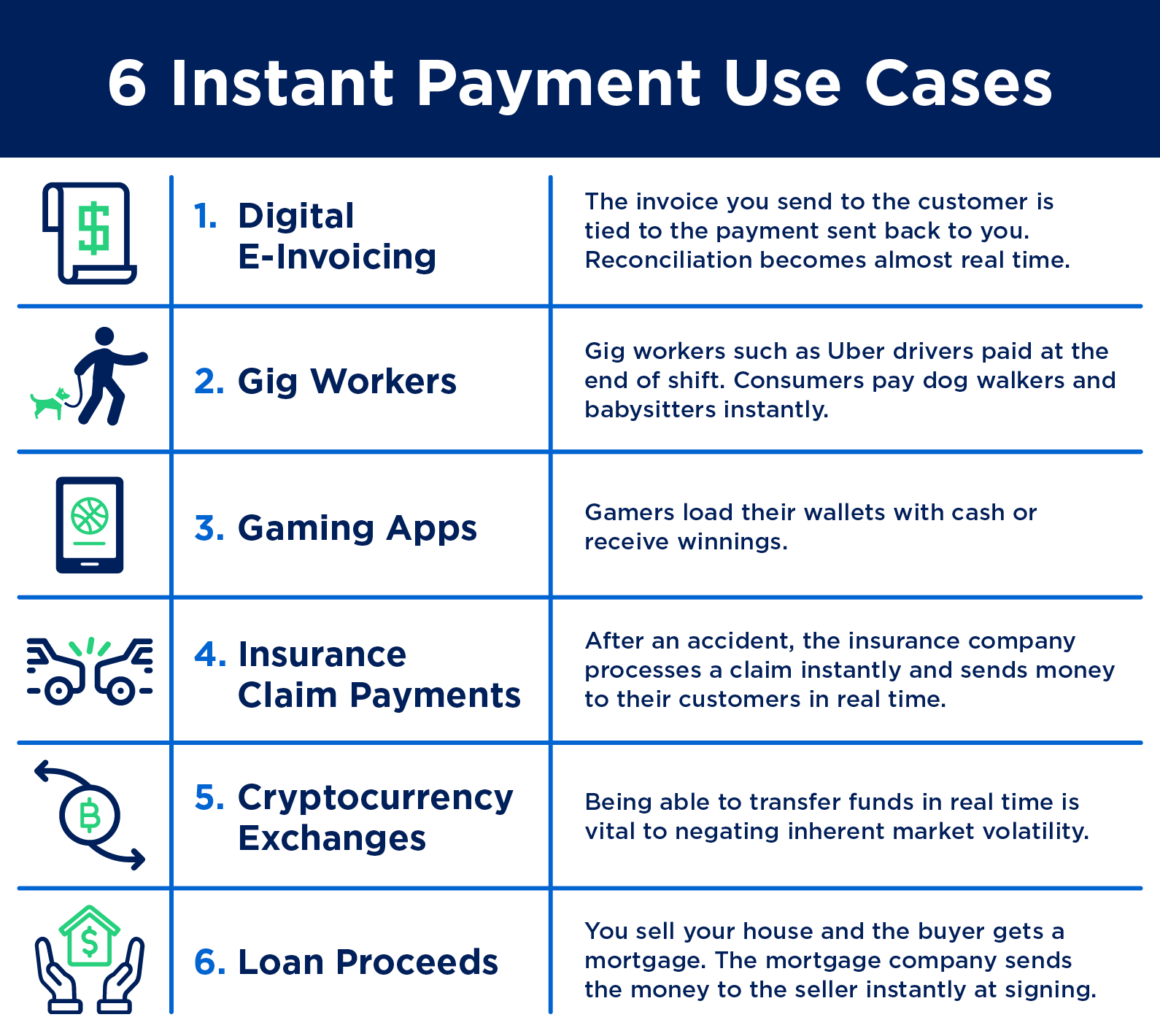
See infographic transcript below
Unlocking opportunities for every business
The growing adoption of instant payments will bring about significant opportunities for businesses of all types. For small and medium-sized organizations, real-time payments can enable better cash flow and make it easier to manage day-to-day operations by improving liquidity. Brokerage services, meanwhile, will benefit from the ability to perform stock sales faster.
The industries that stand to benefit the most, however, are those where there is a clear material advantage to releasing funds as quickly as possible. One such case is in the gaming world, where platforms offering instant payouts will be considerably more popular with consumers. Similarly, for point-of-sale purchases, real-time transfers will not only enhance consumer experience, but reduce costs for merchants as well.
The impact doesn’t stop there. As adoption scales, real-time payments are driving deeper transformation in sectors where speed creates a competitive edge. In the insurance industry, for example, instant payments have enabled companies to settle claims immediately, which could potentially create an entirely new business model.
"We’re hearing that some of the insurance companies today have real-time claims where you can take a picture of the accident with your phone and they can adjudicate the claim while you’re on the phone with the representative," said Chayt.
"With real-time payments, they can then be in a position to push money to their customers in real time such that when people are walking away from the accident scene, they actually have money in their account to go buy a replacement vehicle."
Real-time payments will eventually become so common that they won’t need to be referred to as “instant payments” anymore, as customers abandon slower payments systems in favor of getting paid with the click of a button.
To learn more about this and other treasury tools, contact your Fifth Third relationship manager or find a banker to learn more.